
HiLDA Ground Station
- 320 miles north of the Arctic Circle
Project Overview
In 2021, Quintillion officially launched its High Latitude Data Acquisition (HiLDA) ground station. Located in Utqiaġvik at 72 degrees latitude, 320 miles north of the Arctic Circle. We built the ground station as a US-based downlinking solution for polar-orbiting satellite operators.
It has a 3.7-meter S/X band antenna that is available for occasional use and Ground Station as a Service (GSaaS) applications. The facility also offers dedicated platform leasing bundled with a variety of services —including operations and maintenance (O&M), backhaul, colocation, power, and cloud access.
As the highest latitude ground station on US soil, the Quintillion HiLDA Ground Station offers an advantageous and secure location for American satellite operators to downlink or uplink data. This ground station was designed to serve commercial, military, and government operators.
Constructing a ground station in the Alaska Arctic was no easy feat. We faced many barriers along the way, from building and welding in harsh winter conditions, to figuring out the logistics of transporting heavy equipment to the northernmost location in the country. However, with our talented local team of Alaskans, Quintillion took on the challenge, and we leaped over every hurdle in our way.
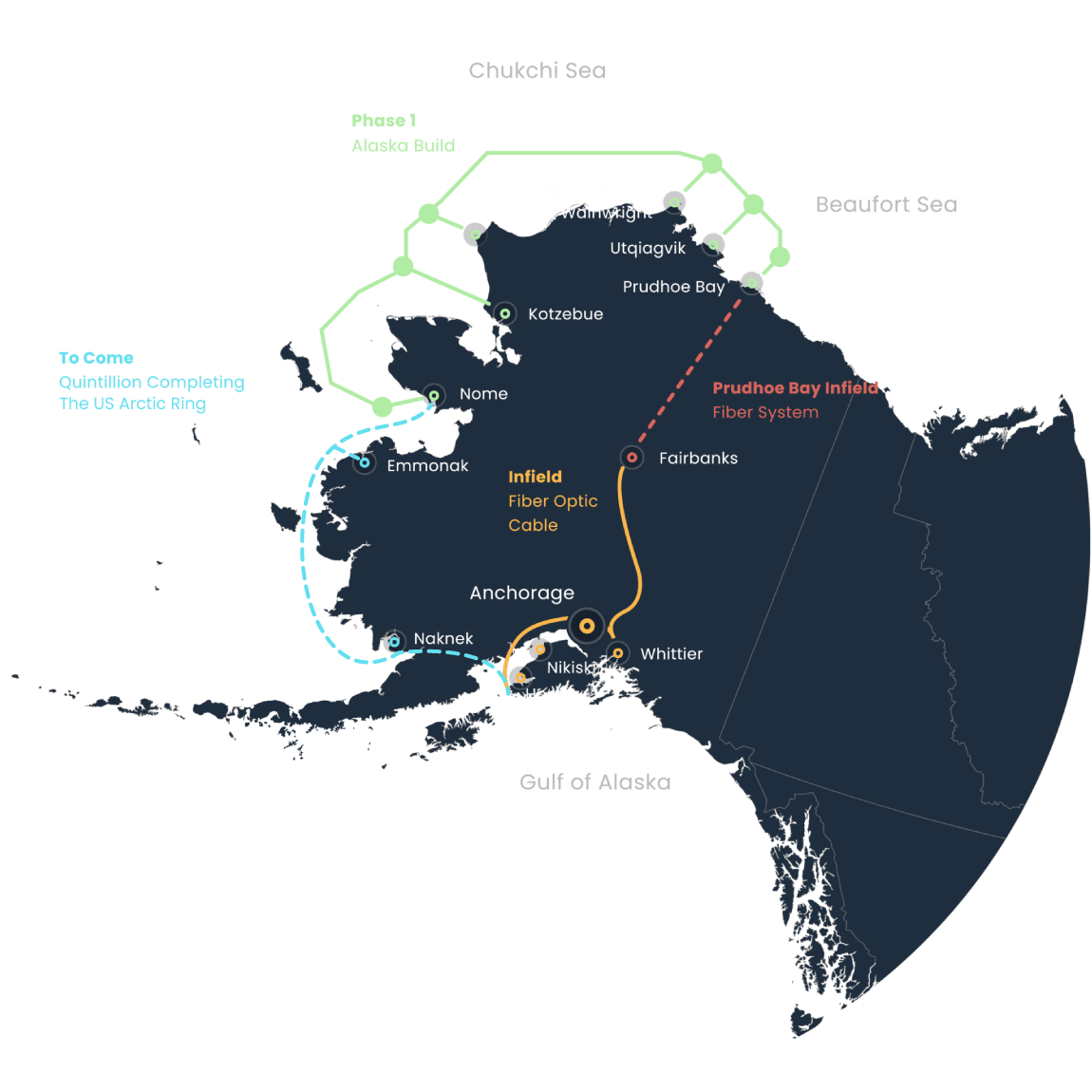
Project Route Map
Ground Station Benefits
High-Latitude Location
Quintillion’s fiber optic cable system lands in Utqiaġvik, which is the northernmost city in the United States and one of the highest-latitude locations in the world. With several natural geographic advantages, this city was an obvious choice for building the HiLDA ground station. A high-latitude ground station enables companies or organizations launching polar-orbiting satellites into space to deliver data multiple times a day as close to real-time as possible. With Quintillion’s ground station, satellite operators can downlink data utilizing a majority of the satellite passes per day.
Secure Location
The HiLDA ground station was built on US soil. This provides US-based companies, government or military organizations, and American allies a neutral, secure location to downlink and process data from space. Additionally, the remote location is not easily accessible, which provides an extra layer of security against possible adversaries. The ground station is further protected with stringent physical protection and cybersecurity measures which include data encryption, access control, and personnel screening.
Fiber Infrastructure
Fiber optic cables are the most reliable and fastest way to relay information gathered from satellites to its intended destination. While many ground station providers rely on other companies to provide a fiber optic cable network they can utilize, Quintillion has the advantage of already owning a fiber optic network. This allows us to not only bundle fiber with our ground station services, but to connect the downlinking facility to major internet exchanges in the lower 48 via fiber as well.
Satellite Tracking Dashboard
Quintillion’s HiLDA ground station is powered by ATLAS Space Operations’ Freedom™ Platform, providing a secure, automated solution for satellite communications. Users can easily schedule satellite passes, monitor performance, and manage data through a streamlined dashboard and API. Built on AWS GovCloud with advanced security features, the platform supports reliable, scalable operations for both government and commercial missions.
Technical Specifications
Network Infrastructure
Cable Type:
Subsea & Terrestrial Fiber
Fiber Pairs:
8-fiber configuration
Capacity:
400+ Gbps per pair
Technology:
DWDM capable
Resilience Features
Burial Depth:
2-3 meters subsea
Armoring:
Double armor in shore zones
Redundancy:
Ring architecture
Monitoring:
24/7 NOC surveillance
The Nome to Homer Express utilizes state-of-the-art subsea fiber optic technology designed specifically for the challenging conditions of Alaska’s coastal waters. The cable system features multiple layers of protection including steel armoring in shore approach zones and specialized burial techniques to protect against ice scour, fishing activities, and seismic events.
Landing sites are strategically located to minimize environmental impact while maximizing network resilience. Each community connection includes redundant power systems, environmental controls for extreme temperatures, and remote monitoring capabilities that enable our network operations center to detect and respond to issues before they impact service.
Frequently Asked Questions
Which communities will benefit from this project?
The Nome to Homer Express system will directly benefit communities in West and Southwest Alaska, including Emmonak, Hooper Bay, Naknek, King Salmon, Igiugig, and Homer, by providing fiber access and communication facilities. Indirectly, the North Slope and Northwest communities will benefit because this system will provide redundant internet access to internet service providers, thereby limiting the effects of fiber cuts or environmental network interruptions.
Why is Quintillion building more fiber?
Optical fiber is the industry gold standard for providing internet connectivity because of its ability to deliver reliable, high-capacity, high-speed broadband with low latency. More fiber will mean more redundancy and resiliency, as well as options for internet service providers, which will increase competition and help to keep costs down. With support from the NTIA Middle Mile Grant, Quintillion’s Nome to Homer Express project will transform the way Alaskans work, learn, and play. This broadband superhighway will connect many communities across Alaska, improving service to U.S. and global interconnectivity and cloud services.
Will there be opportunities for local community members during construction?
How is the fiber being installed?
Optical fiber installation for the Nome to Homer Express project involves both subsea and terrestrial methods. Subsea cables will be laid using specialized vessels and equipment, while terrestrial installation will utilize trenching and directional drilling techniques where applicable. The installation process adheres to industry best practices for telecommunications infrastructure, ensuring the reliability and longevity of the network. Quintillion employs skilled technicians and contractors with expertise in fiber optic deployment to ensure the highest standards of installation quality and performance. In short, Quintillion’s team has many years of experience laying subsea cable and will bring that expertise to bear on this project.
Will Quintillion require facilities in each community?
Quintillion will not require many operational facilities along the Nome to Homer Express broadband project route. Telecom structures will be placed in several locations to house the cable-powering equipment. During the construction phase, facilities for equipment and cable storage will be required. Quintillion will work closely with local authorities and stakeholders to identify suitable locations and ensure that facility requirements align with community needs and regulatory requirements.
How will the project ensure respect for our cultural sites and ancestral lands?
Respect for cultural sites and ancestral lands is paramount in the planning and execution of the Nome to Homer Express project. Quintillion conducts thorough cultural resource surveys and consultations with tribal entities and cultural experts to identify and protect sensitive areas. Quintillion integrates cultural considerations into route planning and construction practices, implementing mitigation measures to avoid disturbing sacred sites and significant cultural resources.
The Nome to Homer Project is funded through an NTIA Middle Mile Grant and is a federal undertaking subject to Section 106 of the National Historic Preservation Act and its implementing regulations at 36 CFR Part 800, which require identification and consideration of potential impacts to historic properties. Quintillion is coordinating closely with Tribal governments, cultural resource specialists, and federal agencies to ensure compliance and to avoid, minimize, or appropriately mitigate impacts to cultural sites and ancestral lands.
Want to Learn More?
Get in touch with our team to learn more about the Nome to Homer Express and how it can serve your community or organization.