
Nome to Homer Express

Discover how a strategic fiber network from Nome to Homer is connecting Alaska’s coastal communities from Nome to Homer, delivering high-speed internet along 894 miles of coastline.

Project Overview

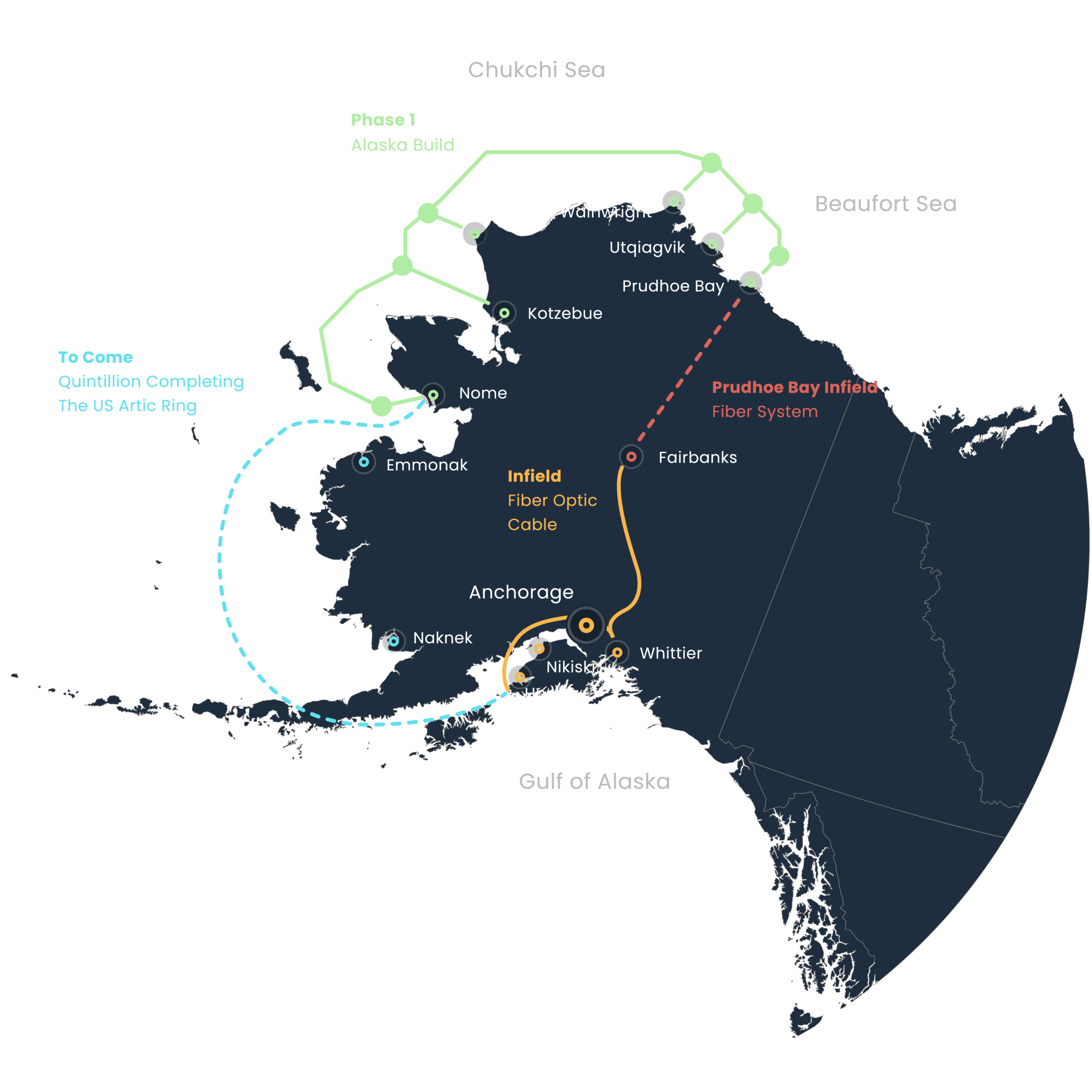
The Nome to Homer Express is a transformative infrastructure project that will complete a vital fiber-optic “ring” around Alaska — connecting Nome in the far northwest to Homer on the Kenai Peninsula, and linking key coastal and rural communities along the way. This route will deliver approximately 950–1,545 miles of subsea and terrestrial fiber, extending Quintillion’s existing network and enabling more robust, reliable middle-mile connectivity for underserved regions.

This project is funded through a combination of private capital and a significant federal grant awarded under the National Telecommunications and Information Administration (NTIA) Middle Mile Broadband Infrastructure Program. The overall investment — combining public and private funding — is approximately $250 million.
Once completed, the Nome to Homer Express will significantly boost network resilience across Alaska. For years, the state’s broadband infrastructure has been dependent on a single subsea fiber path — vulnerable to damage from ice scour, sea anchors, or natural events. By completing the ring, this project ensures traffic can be rerouted around the state in either direction in case of outage, enhancing redundancy and reliability statewide.

Completion of construction is currently targeted for late 2026, with full operational service expected by early 2027 following comprehensive testing. In addition to strengthening Alaska’s digital backbone, Nome to Homer Express opens new connectivity possibilities for remote coastal communities — including Nome, Hooper Bay, Emmonak, Naknek, Igiugig, and Homer, with additional communities planned for network expansion through grant and private funding. Once the ring is live, local service providers will be able to offer high-speed broadband to households, businesses, schools, and healthcare facilities in areas that historically lacked reliable digital access.

Project Route Map

Quintillion_MapSizeIncrease

Community Benefits

Healthcare Access

Reliable connectivity enables telehealth services that allow patients to receive care within their local community. This reduces the need for long-distance travel, making healthcare more convenient, affordable, and accessible.

Educational Opportunities

Reliable connectivity expands learning through online resources, distance education, and digital libraries from K–12 through post-secondary programs. Partnerships like Ilisagvik College in Barrow help connect students to higher-education opportunities.

Economic Development

Local businesses benefit from modern connectivity supporting e-commerce, remote work opportunities, and operational needs. Tourism businesses can handle online bookings and highlight Alaska to global audiences.

Government Services

Alaskans benefit from expanded access to state and federal services, fortified tribal government operations, and resilient public safety communications supporting emergency response coordination across multiple jurisdictions.

Funding Structure

Federal Grants (NTIA Middle Mile & BEAD)

$88.90M

Private Investment (Quintillion)

$71.67M

Total Project Investment

$160.56M

This funding structure demonstrates our commitment to maximizing federal funding opportunities while making significant private investments to ensure project success. Our approach leverages public funding to de-risk infrastructure deployment in economically challenging areas while maintaining our ability to deliver high-quality, sustainable network operations.

Project Timeline

2023-2024

Project Project Awarded

Project Kick-Off

2024-2025

Engineering Design

Permitting

Community/Stakeholder Engagment

Cultural Surveys Studies

Marine Survey

2025-2026

Environmental Assessment Completed

Cable Supply

Procurement

Construction Begins:

Terrestrial FOC Construction

2026

Construction

Submarine Cable Installation Testing

2027

Commissioning

Ready for Service

Technical Specifications

Network Infrastructure

Cable Type:

Subsea & Terrestrial Fiber

Fiber Pairs:

8-fiber configuration

Capacity:

400+ Gbps per pair

Technology:

DWDM capable

Resilience Features

Burial Depth:

2-3 meters subsea

Armoring:

Double armor in shore zones

Redundancy:

Ring architecture

Monitoring:

24/7 NOC surveillance

The Nome to Homer Express utilizes state-of-the-art subsea fiber optic technology designed specifically for the challenging conditions of Alaska’s coastal waters. The cable system features multiple layers of protection including steel armoring in shore approach zones and specialized burial techniques to protect against ice scour, fishing activities, and seismic events.

Landing sites are strategically located to minimize environmental impact while maximizing network resilience. Each community connection includes redundant power systems, environmental controls for extreme temperatures, and remote monitoring capabilities that enable our network operations center to detect and respond to issues before they impact service.

Frequently Asked Questions

Which communities will benefit from this project?

The Nome to Homer Express system will directly benefit communities in West and Southwest Alaska, including Emmonak, Hooper Bay, Naknek, King Salmon, Igiugig, and Homer, by providing fiber access and communication facilities. Indirectly, the North Slope and Northwest communities will benefit because this system will provide redundant internet access to internet service providers, thereby limiting the effects of fiber cuts or environmental network interruptions.

Optical fiber is the industry gold standard for providing internet connectivity because of its ability to deliver reliable, high-capacity, high-speed broadband with low latency. More fiber will mean more redundancy and resiliency, as well as options for internet service providers, which will increase competition and help to keep costs down. With support from the NTIA Middle Mile Grant, Quintillion’s Nome to Homer Express project will transform the way Alaskans work, learn, and play. This broadband superhighway will connect many communities across Alaska, improving service to U.S. and global interconnectivity and cloud services.

As part of Quintillion’s commitment to community engagement, the project may create opportunities for local participation in logistical support, lodging, transportation, and other services that support construction activities.

Optical fiber installation for the Nome to Homer Express project involves both subsea and terrestrial methods. Subsea cables will be laid using specialized vessels and equipment, while terrestrial installation will utilize trenching and directional drilling techniques where applicable. The installation process adheres to industry best practices for telecommunications infrastructure, ensuring the reliability and longevity of the network. Quintillion employs skilled technicians and contractors with expertise in fiber optic deployment to ensure the highest standards of installation quality and performance. In short, Quintillion’s team has many years of experience laying subsea cable and will bring that expertise to bear on this project.

Quintillion will not require many operational facilities along the Nome to Homer Express broadband project route. Telecom structures will be placed in several locations to house the cable-powering equipment. During the construction phase, facilities for equipment and cable storage will be required. Quintillion will work closely with local authorities and stakeholders to identify suitable locations and ensure that facility requirements align with community needs and regulatory requirements.

Respect for cultural sites and ancestral lands is paramount in the planning and execution of the Nome to Homer Express project. Quintillion conducts thorough cultural resource surveys and consultations with tribal entities and cultural experts to identify and protect sensitive areas. Quintillion integrates cultural considerations into route planning and construction practices, implementing mitigation measures to avoid disturbing sacred sites and significant cultural resources.

The Nome to Homer Project is funded through an NTIA Middle Mile Grant and is a federal undertaking subject to Section 106 of the National Historic Preservation Act and its implementing regulations at 36 CFR Part 800, which require identification and consideration of potential impacts to historic properties. Quintillion is coordinating closely with Tribal governments, cultural resource specialists, and federal agencies to ensure compliance and to avoid, minimize, or appropriately mitigate impacts to cultural sites and ancestral lands. 

Want to Learn More?

Get in touch with our team to learn more about the Nome to Homer Express and how it can serve your community or organization.